
Dust Monitor Calibration: How Every Dustlight Device Is Calibrated
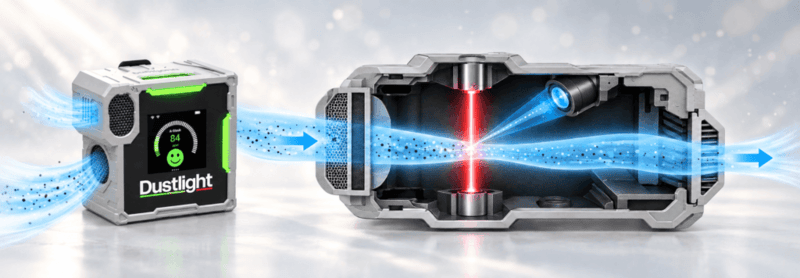
September 29, 2026 If two optical A-dust monitors are placed side by side in the same A-dust environment, they may display different readings. Data sheets rarely explain why this is the case, as there is no uniform standard for particle sensors. Calibrating A-dust monitors is therefore not a single step, but rather a series of tests. Each test addresses a specific question: whether all devices measure the same way, whether […]
Wearable PM Monitoring Update 2026: Ten Changes for Safety Teams
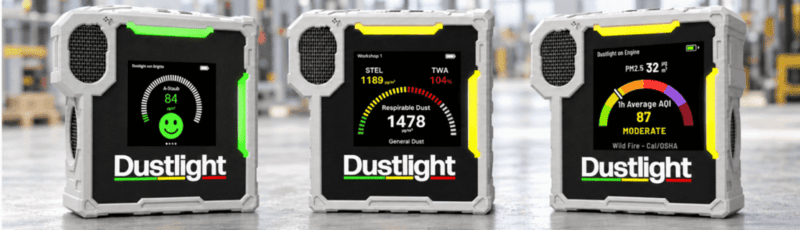
September 9, 2026 Conventional methods for measuring A-dust provide an average exposure value. When combined with laboratory analysis, they show what proportion of the collected A-dust is attributable to a specific substance. What a gravimetric result does not show is the temporal progression of exposure. The same average value can result from continuous exposure, several short peaks, or a single event. It […]
Real-time dust monitoring: Software for analyzing dust exposure

A portable dust meter plays a central role in real-time dust monitoring, making respirable dust visible and enabling immediate response to changing exposure levels. However, real-time dust monitoring alone is not sufficient to ensure the long-term protection of employees. In order to reliably assess exposure, document compliance with limit values, and reduce the administrative burden on SiFa managers, dust measurements must be recorded in meaningful [...]
Dust Measurement Web App for Real-Time Analysis

We are pleased to introduce the new Dustlight Web app - now with enhanced features to make your decisions even faster and smarter. The new Web app, in combination with the smartphone app, gives you anytime, anywhere access to powerful analytical tools to help you better monitor and manage the air quality in your workplaces. [...]
TWA & STEL: What HSE managers need to know about dust exposure
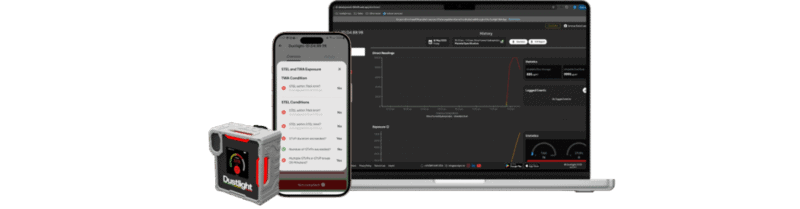
Understanding the Time-Weighted Average (TWA) and Short-Term Exposure Limit (STEL) is critical for anyone responsible for protecting employees from hazardous dust exposure. These metrics provide a clear, quantifiable representation of actual dust exposure - whether continuous over an entire shift (TWA) or in the form of short-term, intense exposure periods [...]
Robust measurement technology for respirable dusts

The current state of the art basically distinguishes between two methods of measuring the particle content of air: the gravimetric and the optical method. Gravimetric particle measurement is based on a very fine filter fabric through which a precisely defined air flow is drawn over a defined period of time using a pump. The dust particles remain trapped in the filter fabric. After collection, the filter is [...]
Calibration factors in real-time dust monitoring: how Dustlight material configurations work
August 19, 2026: Occupational exposure limits are falling—and gravimetric sampling is reaching a physical limit. The method collects dust on a filter and weighs it; however, to obtain a reliable measurement, the scale requires a minimum mass. The lower the limit value, the less mass is collected in the same amount of time: A measurement that used to take two hours now takes […]
Update of TRGS 900 (June 24)

The TRGS900 occupational exposure limit values In order to ensure the safety and health of employees, occupational health and safety in Germany is regulated and structured by numerous laws and ordinances. The Occupational Health and Safety Act (ArbSchG) lays down the basic obligations of the employer, the rights and obligations of employees and the monitoring of occupational health and safety in all areas of activity. This law is supplemented by various [...]