
Inhalable vs respirable dust: particle sizes explained

November 4, 2026 When cutting concrete, emptying bags of powder, and grinding metal, workers may inhale particles of varying sizes and compositions. It is impossible to determine with the naked eye how much of this reaches the breathing zone and which fine particles remain in the air long after the visible cloud has dissipated. This is where the distinction between E-dust and A-dust comes into play […]
Breathing zone monitoring: why dust exposure must be measured where workers breathe

19.10.2026 Occupational exposure limits are written for the air a worker inhales, not for the average air in a production hall. Many exposure assessments still rely on fixed monitors, occasional sampling campaigns or readings taken metres away from the task. Breathing zone monitoring closes this gap by measuring airborne particles within about 30 cm in front of the nose and mouth, where […]
Dust Monitor Calibration: How Every Dustlight Device Is Calibrated
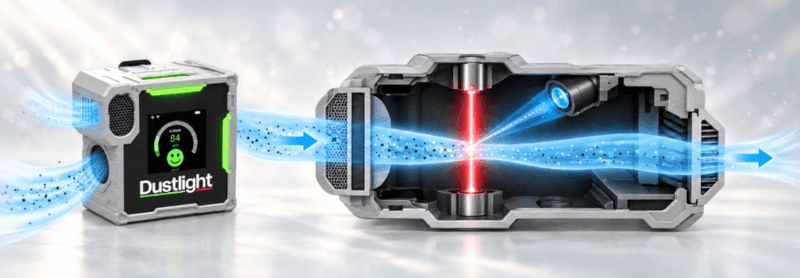
September 29, 2026 If two optical A-dust monitors are placed side by side in the same A-dust environment, they may display different readings. Data sheets rarely explain why this is the case, as there is no uniform standard for particle sensors. Calibrating A-dust monitors is therefore not a single step, but rather a series of tests. Each test addresses a specific question: whether all devices measure the same way, whether […]
Wildfire Smoke Worker Protection: What the AQI at the Worksite Reveals

September 10, 2026 Specific thresholds governing protection against wildfire smoke exist only in part of the world: Two U.S. states have established an air quality index value above which employers are required to take action. Everywhere else, while the obligation exists, a specific threshold is lacking—in Australia, the United Kingdom, and Germany, employers are expected to assess the risk and take appropriate action without […]
Wearable PM Monitoring Update 2026: Ten Changes for Safety Teams
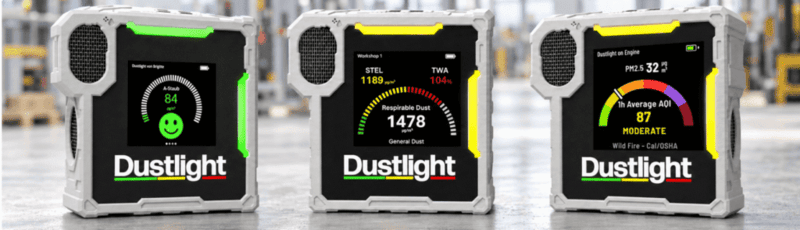
September 9, 2026 Conventional methods for measuring A-dust provide an average exposure value. When combined with laboratory analysis, they show what proportion of the collected A-dust is attributable to a specific substance. What a gravimetric result does not show is the temporal progression of exposure. The same average value can result from continuous exposure, several short peaks, or a single event. It […]
Can a real-time dust monitor detect crystalline silica?

September 9, 2026 Quartz dust is strictly regulated in nearly all industrialized nations. Consequently, the question often arises as to whether a portable measuring device can directly detect it—and the answer determines which method is legally valid and which guides day-to-day work practices. A real-time dust monitor cannot identify quartz dust as a distinct substance. It measures the A-dust concentration; quartz particles are included in this value, […]
Limit of quantification: when a gravimetric result cannot tell a safety team whether it is compliant

August 20, 2026 Gravimetric sampling cannot always confirm whether a workplace complies with the limit values. If the mass collected on the filter is below the laboratory’s limit of quantification, the report does not provide a numerical value—it merely states that the concentration is somewhere below that threshold. If the threshold itself exceeds the applicable limit value, the measurement […]
Gravimetric sampling vs. Real-time dust monitoring: why HSE teams need both

July 17, 2026 Gravimetric and real-time dust measurement address different questions. Gravimetric sampling provides a reliable result for a specified measurement period and remains a central component of formal exposure assessment. Optical real-time measurement with Dustlight, on the other hand, shows how dust levels change over the course of a work shift. It reveals when concentrations rise, which activities may be responsible, and whether protective measures […]
Why silica dust requires continuous exposure visibility

Silica dust is one of the most hazardous types of dust exposure in the workplace. Particularly dangerous is respirable crystalline Silica dust, often referred to as Type A Silica, respirable Silica dust, or, internationally, as Respirable Crystalline Silica (RCS). It is primarily derived from Silica, a natural component of stone, sand, concrete, cement, mortar, and many mineral-based materials. When this material is cut, drilled, ground, milled, crushed, or […]
Real-time dust monitoring: Software for analyzing dust exposure

A portable dust meter plays a central role in real-time dust monitoring, making respirable dust visible and enabling immediate response to changing exposure levels. However, real-time dust monitoring alone is not sufficient to ensure the long-term protection of employees. In order to reliably assess exposure, document compliance with limit values, and reduce the administrative burden on SiFa managers, dust measurements must be recorded in meaningful [...]